
Developers
Webhooks
A webhook is a request QuickPay sends to your server when something happens, such as a paid checkout. Use it to mark orders paid without polling the API.
Add an endpoint
- In the dashboard, open Developers, then the Webhooks tab, and press Add endpoint.
- Enter your server's URL. It must be
https, such ashttps://shop.example/webhooks/quickpay. - Tick the Events you want, then press Add.
- QuickPay shows the endpoint's signing secret once. Copy it into your server's configuration, then press I saved it.
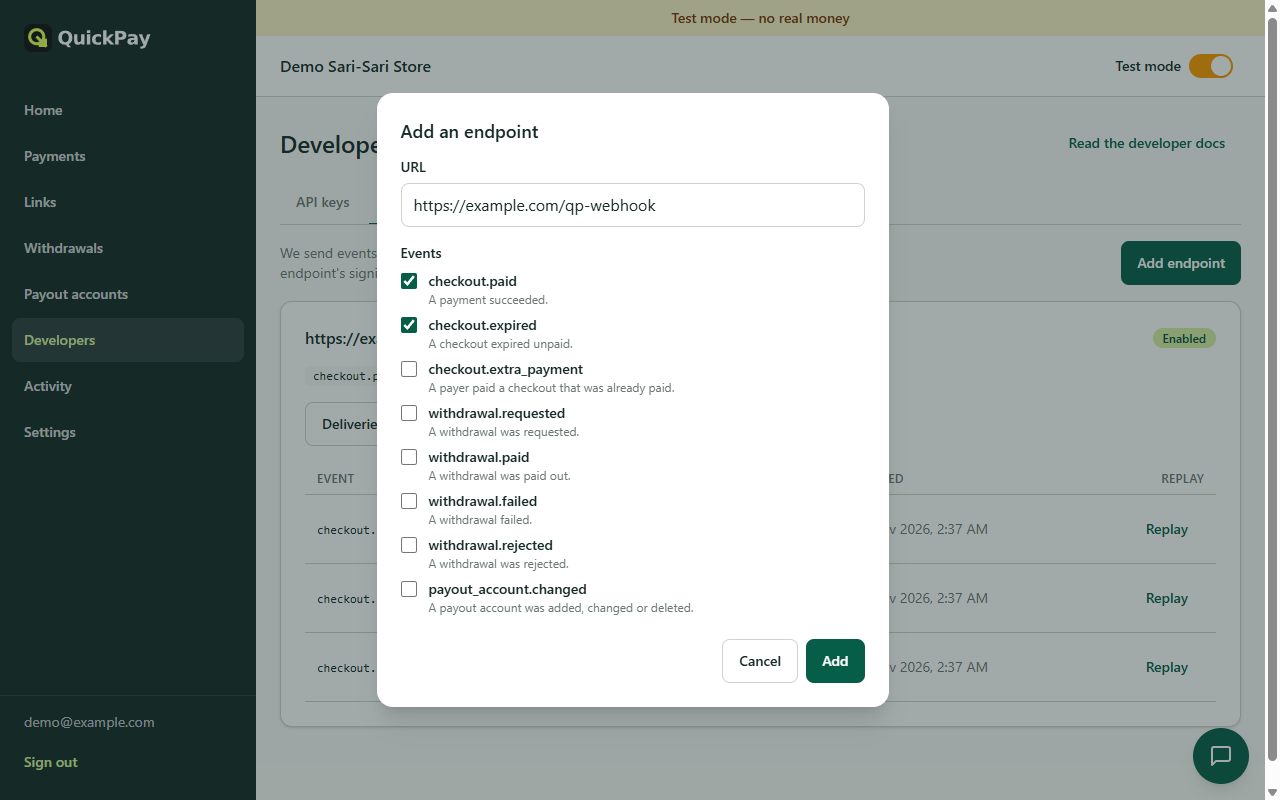
Each endpoint can be Disabled and enabled again, and Rotate secret makes a new signing secret. The old secret stops working at once, so put the new one on your server right away.
Events
Every delivery is a POST with a JSON body like this:
{
  "id": "evt_5f0c3a9e1b7d2c4a6e8f0b1d",
  "type": "checkout.paid",
  "created_at": "2026-11-17T03:10:42Z",
  "livemode": true,
  "data": { ... }
}| Event | When | data |
|---|---|---|
checkout.paid | A checkout was paid. | The checkout |
checkout.expired | A checkout expired unpaid. | The checkout |
checkout.extra_payment | A payer paid a checkout that was already paid. The money is in your balance too. | checkout and payment |
withdrawal.requested | A withdrawal was made. | The withdrawal |
withdrawal.paid | A withdrawal arrived. | The withdrawal |
withdrawal.failed | A withdrawal failed; the amount is back in your balance. | The withdrawal |
withdrawal.rejected | QuickPay refused a withdrawal; the amount is back in your balance. | The withdrawal |
payout_account.changed | A payout account was added, changed or deleted. | The account's id, the action, the bank and the last 4 digits |
checkout.paid
{
  "id": "evt_5f0c3a9e1b7d2c4a6e8f0b1d",
  "type": "checkout.paid",
  "created_at": "2026-11-17T03:10:42Z",
  "livemode": true,
  "data": {
    "id": "cs_8Q2M4X7RJK1V9TNC3H6PWZ5D",
    "object": "checkout",
    "livemode": true,
    "status": "paid",
    "amount": 150000,
    "amount_display": "₱1,500.00",
    "fee": 1500,
    "fee_display": "₱15.00",
    "net_amount": 148500,
    "net_amount_display": "₱1,485.00",
    "currency": "PHP",
    "reference": "order-1001",
    "description": "2 x T-shirt",
    "url": "https://quickpayph.com/c/cs_8Q2M4X7RJK1V9TNC3H6PWZ5D",
    "expires_at": "2026-11-17T04:04:05Z",
    "paid_at": "2026-11-17T03:10:41Z",
    "source": "api",
    "created_at": "2026-11-17T03:04:05Z",
    "metadata": {"order_id": "1001"},
    "payer": {"name": "Juan dela Cruz", "email": "[email protected]"}
  }
}
checkout.expired
{
  "id": "evt_0a1b2c3d4e5f60718293a4b5",
  "type": "checkout.expired",
  "created_at": "2026-11-17T04:04:30Z",
  "livemode": true,
  "data": {
    "id": "cs_8Q2M4X7RJK1V9TNC3H6PWZ5D",
    "object": "checkout",
    "livemode": true,
    "status": "expired",
    "amount": 150000,
    "amount_display": "₱1,500.00",
    "fee": 1500,
    "fee_display": "₱15.00",
    "net_amount": 148500,
    "net_amount_display": "₱1,485.00",
    "currency": "PHP",
    "reference": "order-1001",
    "description": "2 x T-shirt",
    "url": "https://quickpayph.com/c/cs_8Q2M4X7RJK1V9TNC3H6PWZ5D",
    "expires_at": "2026-11-17T04:04:05Z",
    "paid_at": null,
    "created_at": "2026-11-17T03:04:05Z",
    "metadata": {"order_id": "1001"},
    "payer": {}
  }
}
checkout.extra_payment
A second payment arrived for a checkout that was already paid, for example when a payer scanned the QR twice. It is credited to your balance; refund the payer yourself if you need to.
{
  "id": "evt_9e8d7c6b5a4f3e2d1c0b9a87",
  "type": "checkout.extra_payment",
  "created_at": "2026-11-17T03:12:09Z",
  "livemode": true,
  "data": {
    "checkout": { "id": "cs_8Q2M4X7RJK1V9TNC3H6PWZ5D", "object": "checkout", "status": "paid", ... },
    "payment": {
      "id": 48213,
      "channel": "gcash",
      "amount": 150000,
      "amount_display": "₱1,500.00",
      "fee": 1500,
      "fee_display": "₱15.00",
      "net_amount": 148500,
      "net_amount_display": "₱1,485.00",
      "paid_at": "2026-11-17T03:12:08Z"
    }
  }
}withdrawal.requested, withdrawal.paid, withdrawal.failed, withdrawal.rejected
All four carry the withdrawal as it is after the change. Here is withdrawal.paid:
{
  "id": "evt_1f2e3d4c5b6a798817263544",
  "type": "withdrawal.paid",
  "created_at": "2026-11-17T05:21:16Z",
  "livemode": true,
  "data": {
    "id": "wd_6M3K9Q2X7V1T8N4C5R0JHPWZ",
    "object": "withdrawal",
    "livemode": true,
    "status": "paid",
    "amount": 100000,
    "amount_display": "₱1,000.00",
    "fee": 1500,
    "fee_display": "₱15.00",
    "net_amount": 98500,
    "net_amount_display": "₱985.00",
    "currency": "PHP",
    "destination": {
      "payout_account_id": "pa_2H7W4N9K1Q6X3M8V5T0CRJZP",
      "bank_id": 27,
      "bank_name": "GCash (GC)",
      "account_name": "Juan dela Cruz",
      "account_number_masked": "*******1234"
    },
    "payout_reference": null,
    "failure_reason": null,
    "created_at": "2026-11-17T05:20:02Z",
    "paid_at": "2026-11-17T05:21:15Z",
    "updated_at": "2026-11-17T05:21:15Z"
  }
}
On withdrawal.requested the status is pending; on withdrawal.failed and withdrawal.rejected it is failed or rejected and failure_reason says why.
payout_account.changed
{
  "id": "evt_7a6b5c4d3e2f1a0b9c8d7e6f",
  "type": "payout_account.changed",
  "created_at": "2026-11-17T02:00:00Z",
  "livemode": true,
  "data": {
    "id": "pa_2H7W4N9K1Q6X3M8V5T0CRJZP",
    "action": "created",
    "bank_name": "GCash (GC)",
    "number_last4": "1234"
  }
}
action is created, updated or deleted. Payout accounts serve both modes, so this event is always "livemode": true. Do not drop it for being live. If you did not make the change, sign in and check your account.
Check livemode before you act
Test events go to the same endpoints, signed with the same secret, with "livemode": false. Before you ship an order on checkout.paid, fetch the checkout with your live key (GET /api/v1/checkouts/{id}) and check that it is paid and that the amount is what you expect. Anyone with a test key can make a test checkout with your order's reference.
Check the signature
Every delivery has two headers:
QuickPay-Signature: t=1763348645,v1=5f2b8c...e9
QuickPay-Event-Id: evt_5f0c3a9e1b7d2c4a6e8f0b1d
t is the Unix time QuickPay sent it. v1 is the hex HMAC-SHA256 of t, a dot and the raw request body, keyed with your endpoint's signing secret. To check it:
- Read the raw body, exactly as received, before you parse the JSON.
- Compute HMAC-SHA256 of
t + "." + bodywith your secret, as lowercase hex. - Compare it with
v1in constant time. - Refuse a
tmore than 5 minutes from your clock, so an old delivery cannot be sent to you again.
Node.js
const crypto = require('node:crypto')

function verify(secret, header, rawBody) {
  const parts = Object.fromEntries(header.split(',').map((p) => p.split('=', 2)))
  const t = Number(parts.t)
  if (!Number.isInteger(t) || !parts.v1) return false
  if (Math.abs(Date.now() / 1000 - t) > 300) return false
  const want = crypto.createHmac('sha256', secret).update(`${parts.t}.`).update(rawBody).digest('hex')
  const a = Buffer.from(want), b = Buffer.from(parts.v1)
  return a.length === b.length && crypto.timingSafeEqual(a, b)
}

// With Express, take the body raw:
app.post('/webhooks/quickpay', express.raw({ type: 'application/json' }), (req, res) => {
  if (!verify(process.env.QUICKPAY_WEBHOOK_SECRET, req.get('QuickPay-Signature') || '', req.body)) {
    return res.sendStatus(400)
  }
  const event = JSON.parse(req.body)
  res.sendStatus(200) // answer first, then do the slow work
  handle(event)
})
Python
import hashlib
import hmac
import time


def verify(secret: str, header: str, body: bytes, now: float | None = None) -> bool:
    parts = dict(p.split("=", 1) for p in header.split(",") if "=" in p)
    ts, sig = parts.get("t", ""), parts.get("v1", "")
    if not ts.isdigit() or not sig:
        return False
    if abs((time.time() if now is None else now) - int(ts)) > 300:
        return False
    want = hmac.new(secret.encode(), ts.encode() + b"." + body, hashlib.sha256).hexdigest()
    return hmac.compare_digest(want, sig)


# With Flask, use the raw body:
# @app.post("/webhooks/quickpay")
# def quickpay_webhook():
#     if not verify(os.environ["QUICKPAY_WEBHOOK_SECRET"],
#                   request.headers.get("QuickPay-Signature", ""), request.get_data()):
#         abort(400)
#     event = json.loads(request.get_data())
#     ...
#     return "", 200
Go
import (
	"crypto/hmac"
	"crypto/sha256"
	"encoding/hex"
	"strconv"
	"strings"
	"time"
)

func verify(secret, header string, body []byte, now time.Time) bool {
	var ts, sig string
	for _, part := range strings.Split(header, ",") {
		k, v, _ := strings.Cut(part, "=")
		switch k {
		case "t":
			ts = v
		case "v1":
			sig = v
		}
	}
	t, err := strconv.ParseInt(ts, 10, 64)
	if err != nil || sig == "" {
		return false
	}
	if d := now.Sub(time.Unix(t, 0)); d > 5*time.Minute || d < -5*time.Minute {
		return false
	}
	mac := hmac.New(sha256.New, []byte(secret))
	mac.Write([]byte(ts + "."))
	mac.Write(body)
	want := hex.EncodeToString(mac.Sum(nil))
	return hmac.Equal([]byte(want), []byte(sig))
}
Answer with 2xx
- Answer any
2xxstatus within 10 seconds to accept the event. Do slow work, such as sending emails, after you answer. - Delivery is at least once: the same event can come more than once. Use the event
id(also in theQuickPay-Event-Idheader) to skip one you already handled. - Events can arrive out of order. Read the object's
statusrather than counting on the order. - Redirects are not followed, and QuickPay never sends to a private or local address.
Retries
Any other answer (another status, a timeout, a refused connection) is retried: after 30 seconds, then 1, 2, 4 minutes and so on, doubling up to every 6 hours, for 72 hours from when the event was made. After that the delivery is marked Failed.
A disabled endpoint is sent nothing. Its deliveries wait, and resume if you enable it again within those 72 hours.
Deliveries and replay
Press Deliveries on an endpoint to see each delivery: the event, its status (Pending, Delivered or Failed), the status code your server answered, the number of attempts and when it was made. Replay sends a delivery again, with the same event and the same id, for example after you fixed a bug in your receiver.
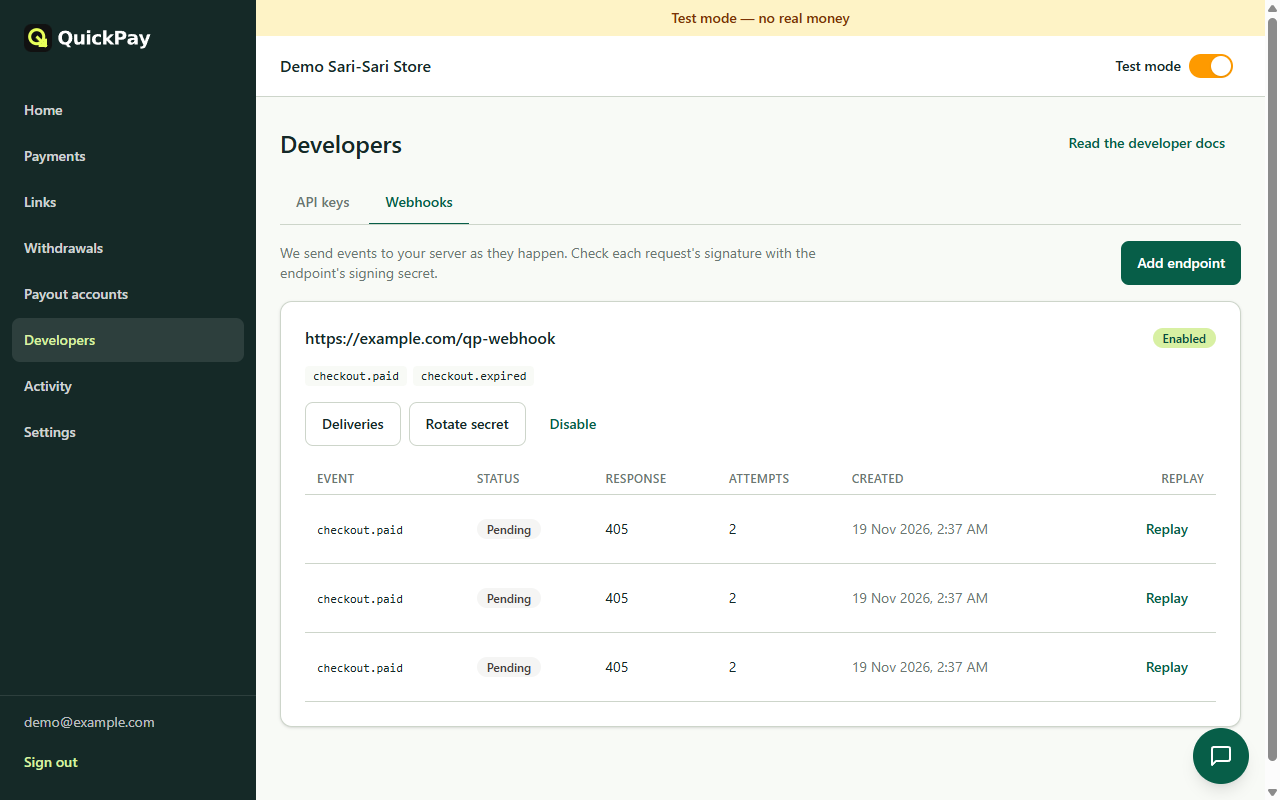
To try your receiver, create a test checkout and simulate a payment: your endpoint gets checkout.paid with "livemode": false.